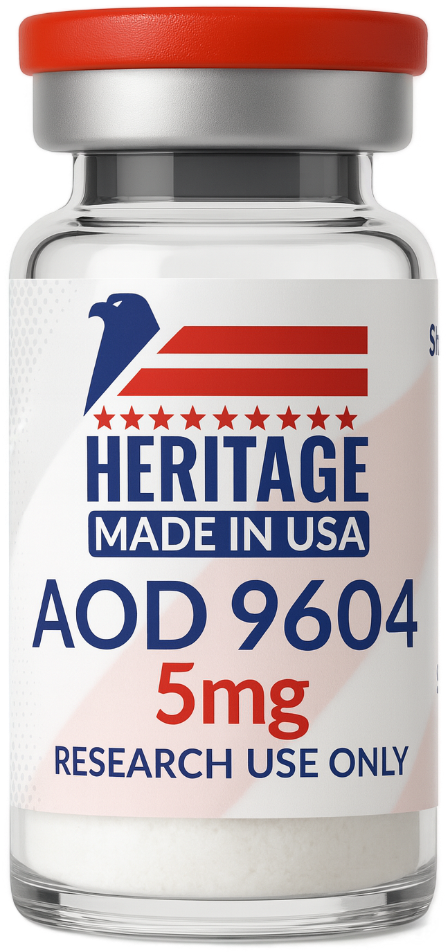
What is AOD-9604?
AOD-9604 stands for "Advanced Obesity Drug" — not the most creative name, but it tells you exactly what this peptide was designed for. It's a synthetic fragment of human growth hormone, specifically the tail end (amino acids 177–191) with an extra tyrosine tacked onto the front. Developed by Metabolic Pharmaceuticals out of Australia, the whole idea was to isolate the fat-burning properties of growth hormone while leaving behind the parts that mess with blood sugar and promote unwanted growth.
How does it work? It ramps up lipolysis (fat breakdown) and puts the brakes on lipogenesis (fat creation) through the beta-3 adrenergic receptor pathway. What makes it interesting is everything it doesn't do: it doesn't bind the GH receptor, doesn't spike IGF-1, and doesn't touch insulin sensitivity or blood glucose. That selectivity is rare.
The animal data is solid — obese Zucker rats lost significant fat without losing lean mass [1]. Phase 2 human trials showed statistically significant weight loss over placebo [3]. And in a fairly unusual move for a peptide, the FDA granted it GRAS status in 2010 as a food supplement ingredient.
Mechanism of Action
AOD-9604 burns fat through a completely different route than full-length growth hormone. Here's how each piece works:
Beta-3 Adrenergic Receptor Pathway
AOD-9604 hits the beta-3 adrenergic receptor (ADRB3) on fat cells. This receptor lives primarily in visceral and brown adipose tissue. Once activated, it kicks off the cAMP-PKA cascade, which lights up hormone-sensitive lipase (HSL) and starts breaking triglycerides down into free fatty acids and glycerol — the building blocks your body can actually burn for energy [1].
Lipogenesis Inhibition
It's not just breaking fat down — it's also blocking your body from making new fat. AOD-9604 dials back acetyl-CoA carboxylase (ACC) and fatty acid synthase (FAS), the two enzymes that gate-keep new fat production. So you're hitting both sides of the equation at once: more fat out, less fat in. Most fat-loss agents only do one or the other [2].
Selectivity Over Full-Length GH
This is really the selling point of AOD-9604: it's what the peptide doesn't do. No GH receptor binding. No IGF-1 elevation. No insulin sensitivity changes. No blood glucose swings. No bone growth effects. You get the fat metabolism benefits without the diabetes risk and acromegaly concerns that come with injecting full-length growth hormone.
Cartilage Regeneration
Here's a bonus nobody expected: AOD-9604 seems to help cartilage too. It stimulates proteoglycan synthesis in joint cartilage, which has opened up a whole new line of osteoarthritis research. This appears to be completely separate from the fat metabolism pathway — likely a different receptor interaction altogether.
Dosing Protocol
Timing matters with AOD-9604 — you want an empty stomach. Eating, especially fats and carbs, can blunt the lipolytic response and undercut what the peptide is trying to do.
| Protocol | Dose | Frequency | Duration | Notes |
|---|---|---|---|---|
| Standard | 300 mcg | Once daily, AM fasted | 12 weeks | Most commonly referenced in literature |
| Split dose | 150 mcg | Twice daily (AM + pre-sleep) | 12 weeks | Mimics pulsatile pattern |
| Cycle | 300 mcg/day | Once daily | 12 weeks on, 4 off | Standard cycling approach |
- Always inject fasted. Wait at least 20–30 minutes before you eat anything.
- Most people inject first thing in the morning before breakfast — you're already fasted from sleep, so the timing is natural.
- If you're splitting doses, make sure your evening shot comes at least 2 hours after your last meal.
- Tolerance doesn't seem to be an issue with AOD-9604, but cycling 12 weeks on / 4 weeks off is standard practice.
Reconstitution Guide
AOD-9604 reconstitutes easily with bacteriostatic water. It dissolves fast and doesn't need much coaxing.
- Remove the plastic cap from the AOD-9604 vial and wipe the rubber stopper with an alcohol swab. Allow to dry.
- Draw
2 mLof bacteriostatic water into a sterile syringe. For a 5 mg vial, this yields a concentration of2,500 mcg/mL. - Insert the needle through the rubber stopper at a slight angle. Inject the water slowly against the inner wall of the vial — do not spray directly onto the peptide powder.
- Allow the vial to sit for 1–2 minutes. Gently roll the vial between your palms if needed. Do not shake or vortex.
- The solution should be completely clear and colorless. Discard if you observe any cloudiness, particulate matter, or discoloration.
5 mg vial + 2 mL BAC water: Concentration = 2,500 mcg/mL
300 mcg dose = 12 units (0.12 mL) on a 100-unit insulin syringe
150 mcg dose = 6 units (0.06 mL) on a 100-unit insulin syringe
Doses per vial: ~16 doses at 300 mcg, or ~33 doses at 150 mcg
- 6 vials AOD-9604 (5 mg each) — provides 30 mg total, covers 84 doses of 300 mcg with margin
- 2 vials bacteriostatic water (30 mL each)
- 84 insulin syringes (29–31 gauge, 100-unit)
- Alcohol prep pads
Injection Technique
AOD-9604 goes subcutaneous (SubQ). For fat-loss work, most people inject into the abdomen — there's a logic to putting it near the fat you're targeting, though the peptide works systemically either way.
- Clean the injection site with an alcohol swab and allow it to air dry completely (approximately 30 seconds). Common sites: lower abdomen (2 inches from the navel), upper thigh, or upper arm.
- Draw the dose. Insert the needle into the vial through the rubber stopper. Invert the vial and draw the calculated number of units slowly. Tap the syringe to move any air bubbles to the top, then push them out gently.
- Pinch the skin at the injection site to create a fold of subcutaneous tissue. Insert the needle at a 45- to 90-degree angle in a quick, smooth motion. Release the skin fold.
- Inject slowly. Depress the plunger steadily over 5–10 seconds. Withdraw the needle at the same angle it was inserted. Apply gentle pressure with a clean swab if needed.
Move your injection sites around to avoid lipodystrophy (weird fat tissue changes under the skin). A clock pattern around the navel works well. The good news is that AOD-9604 volumes are tiny (0.12 mL), so the injection is over before you know it. Keep at least 1 inch between sites.
Storage & Stability
Nothing unusual here — standard peptide storage rules apply. Get this right and your vials will stay potent through the full cycle.
- Store vials upright, out of direct light.
- If you pull a cold vial from the fridge and see condensation, let it warm up before you open it. Moisture getting in is bad news.
- Never re-freeze a reconstituted vial. If it sat out at room temp for more than 4 hours, toss it.
- Pro tip: label your vials with the reconstitution date so you know exactly when the 30-day clock started.
Side Effects & Considerations
Safety-wise, AOD-9604 looks about as clean as a peptide can. In both animal studies and Phase 2 human trials, side effects tracked right alongside placebo.
Commonly Reported
- Mild injection site stuff — a little redness or irritation that clears up fast.
- Occasional headaches, but they're brief and not common.
Key Safety Features
- No impact on blood glucose, insulin, IGF-1, or cortisol in clinical studies [3]. That's a big deal.
- No anti-hGH antibody formation showed up in trials.
- FDA GRAS status since 2010 — they consider it safe enough for food supplement use.
- Needs to be taken fasted; eating can reduce how well it works.
- Zero growth-promoting effects, so it's an option even where GH receptor stimulation would be off the table.
AOD-9604 is a research peptide. Yes, it has GRAS status from the FDA for food supplement use, but it's not approved as a pharmaceutical drug. Everything you've read here comes from published research — it's not medical advice.
Stacking Protocols
AOD-9604 plays well with others. Here are the combinations that show up most often in body composition research.
AOD-9604 + Ipamorelin + CJC-1295 (Body Composition Stack)
This is a popular three-way combo. AOD-9604 handles the direct fat burning, while Ipamorelin and CJC-1295 boost your own growth hormone output to support lean mass. Since all three work through completely different pathways, there's no receptor competition — they don't step on each other's toes.
| Peptide | Dose | Frequency | Duration |
|---|---|---|---|
| AOD-9604 | 300 mcg | Once daily (AM fasted) | 12 weeks |
| Ipamorelin | 200 mcg | 2–3x daily (fasted) | 8–12 weeks |
| CJC-1295 (no DAC) | 100 mcg | 2–3x daily with Ipamorelin | 8–12 weeks |
Lifestyle Factors
A peptide isn't a magic bullet. These lifestyle factors can make a real difference in how much you get out of AOD-9604:
- Stretch your fasting window: Inject first thing in the morning and hold off on breakfast for 30–60 minutes. That extended fasted state gives the peptide more room to work.
- Fasted cardio: Light to moderate cardio after your morning injection can amplify the fat-burning effect. The fatty acids AOD-9604 mobilizes get oxidized faster during exercise.
- Eat right: A moderate caloric deficit with enough protein (1.2–1.6 g/kg body weight, or roughly 0.5–0.7 g/lb) protects lean tissue while you're cutting fat.
- Sleep: Get your 7–9 hours. Skimping on sleep spikes cortisol, which drives visceral fat storage — the exact opposite of what you're trying to do.
AOD-9604 is available in 5 mg vials from Heritage Labs USA, a U.S.-based research peptide supplier with batch-level purity verification.
- Third-party purity testing (HPLC & MS)
- U.S.-based fulfillment
- Published COAs per lot
Literature & Citations
- Heffernan M, Summers RJ, Thorburn A, et al. The effects of human GH and its lipolytic fragment (AOD9604) on lipid metabolism. Endocrinology. 2001;142(12):5182-5189. PubMed
- Ng FM, Sun J, Sharma L, et al. Metabolic studies of a synthetic lipolytic domain (AOD9604) of human growth hormone. Horm Res. 2000;53(5):274-278. PubMed
- Stier H, Vos E, Kenley D. Safety and tolerability of the hexadecapeptide AOD9604 in humans. J Endocrinol Invest. 2013;36(3):174-180. PubMed
- Heffernan MA, Jiang WJ, Thorburn AW, Ng FM. Effects of oral administration of a synthetic fragment of human growth hormone on lipid metabolism. Am J Physiol Endocrinol Metab. 2000;279(3):E501-E507. PubMed
- Ng FM, Bornstein J. Hyperglycemic action of synthetic C-terminal fragments of human growth hormone. Am J Physiol. 1978;234(5):E521-E526. PubMed