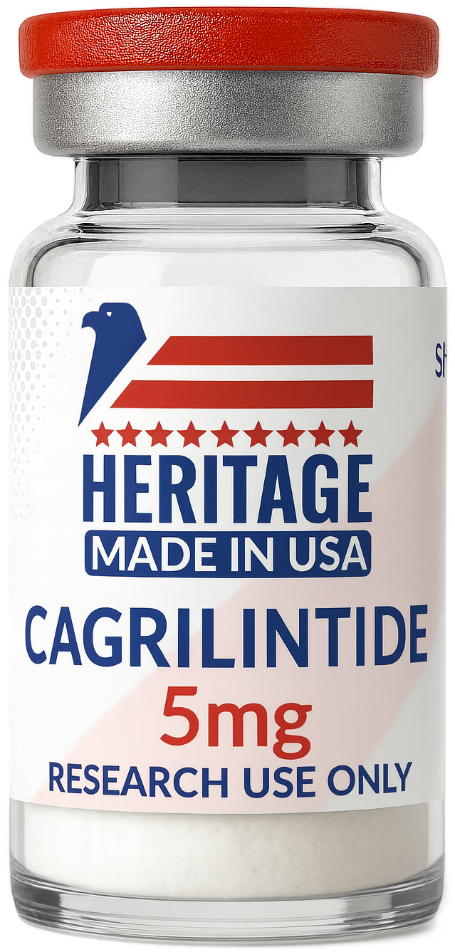
What is Cagrilintide?
Cagrilintide is Novo Nordisk's take on amylin — a hormone your pancreas normally releases alongside insulin after meals. The natural version only lasts about 13 minutes in your blood, which is useless therapeutically. So they added an acyl chain that lets it bind to albumin, stretching the half-life to about 7 days. That's what makes once-weekly dosing possible.
Why does amylin matter for weight loss? It works through a completely different brain circuit than GLP-1 drugs like semaglutide. GLP-1 acts mainly on your hypothalamus. Amylin hits the hindbrain — the area postrema and nearby regions — to promote satiety, slow gastric emptying, and suppress glucagon after meals. Because these pathways don't overlap, combining both could produce additive weight loss. That's exactly the theory behind CagriSema (cagrilintide + semaglutide).
The numbers so far are encouraging. In the Phase 2 trial, 4.5 mg cagrilintide alone produced 10.8% body weight reduction at 26 weeks (versus 3.0% placebo). Pair 2.4 mg cagrilintide with 2.4 mg semaglutide and you get 15.6% at 32 weeks — beating semaglutide by itself. Phase 3 trials (the REDEFINE program) are still running.
Mechanism of Action
Everything cagrilintide does starts with activating amylin receptors in the brain — through pathways that GLP-1 drugs don't touch.
Amylin Receptor Activation
The receptors themselves are heterodimers — calcitonin receptor (CTR) paired with receptor activity-modifying proteins (RAMPs). Cagrilintide binds them in two key hindbrain areas: the area postrema and the nucleus of the solitary tract (NTS). These are the regions that process "I'm full" signals from your gut. Activate them, and you eat smaller meals and stop eating sooner [1].
Gastric Emptying & Glucagon Suppression
Just like natural amylin (and pramlintide, which is already FDA-approved), cagrilintide slows your stomach emptying so you feel full longer after eating. It also suppresses glucagon release from alpha cells after meals, which cuts hepatic glucose output. Both of these effects play nicely with incretin-based therapies — they're attacking the same problem from different angles [3].
Distinct Neuronal Circuitry
This is the key insight: amylin and GLP-1 work in different parts of the brain. GLP-1 signals through the hypothalamic arcuate nucleus (NPY/AgRP and POMC neurons). Amylin works primarily in the hindbrain. Because the wiring doesn't overlap, you can stack both without just doubling the same signal — you actually get additive appetite suppression [2].
Long-Acting Pharmacokinetics
Natural amylin burns through your bloodstream in about 13 minutes — way too fast to be therapeutic. Cagrilintide's acyl chain hitches a ride on albumin in your blood, keeping the peptide circulating for roughly 7 days. One injection per week, and receptors stay activated the whole time.
Dosing Protocol
You don't jump to the full dose — cagrilintide requires a slow ramp-up to keep nausea manageable. This escalation schedule mirrors what was used in the Phase 2 trials.
| Phase | Dose | Frequency | Duration | Notes |
|---|---|---|---|---|
| Initiation | 0.25 mg | Once weekly | Weeks 1–2 | Initial titration |
| Escalation 1 | 0.5 mg | Once weekly | Weeks 3–4 | Continued titration |
| Escalation 2 | 1.0 mg | Once weekly | Weeks 5–6 | Low therapeutic range |
| Escalation 3 | 2.4 mg | Once weekly | Weeks 7–8 | Mid therapeutic dose; CagriSema combination dose |
| Target | 4.5 mg | Once weekly | Week 9+ | Highest studied monotherapy dose |
- Don't skip escalation steps. Nausea gets significantly worse if you rush the titration.
- Pick a day of the week and stick with it. The 7-day half-life keeps receptors activated between injections.
- In CagriSema studies, they used 2.4 mg cagrilintide + 2.4 mg semaglutide. You may not need the full 4.5 mg monotherapy dose when you're combining it with a GLP-1 agonist.
- Even the 1.2 mg dose level showed clinically meaningful weight loss (~8%) in Phase 2 — you don't have to max out to see results.
Reconstitution Guide
Standard BAC water reconstitution. Cagrilintide dissolves without fuss. Don't shake the vial.
- Remove the plastic cap from the vial and wipe the rubber stopper with an alcohol swab. Allow to dry completely.
- Draw
2 mLof bacteriostatic water into a sterile syringe. For a 5 mg vial, this yields a concentration of2.5 mg/mL. - Insert the needle through the rubber stopper at a slight angle. Inject the water slowly against the inner wall of the vial — do not spray directly onto the peptide powder.
- Allow the vial to sit for 1–2 minutes. Gently roll the vial between your palms if needed. Do not shake or vortex.
- The solution should be completely clear and colorless. Discard if you observe any cloudiness, particulate matter, or discoloration.
5 mg vial + 2 mL BAC water: Concentration = 2.5 mg/mL
0.25 mg dose = 10 units (0.1 mL) on a 100-unit insulin syringe
0.5 mg dose = 20 units (0.2 mL) on a 100-unit insulin syringe
1.0 mg dose = 40 units (0.4 mL) on a 100-unit insulin syringe
2.4 mg dose = 96 units (0.96 mL) on a 100-unit insulin syringe
Doses per vial at 2.4 mg: ~2 doses per vial
- 1 vial Cagrilintide (5 mg) — covers weeks 1–6 (0.25–1.0 mg doses)
- 4 vials Cagrilintide (5 mg) — covers weeks 7–16 at 2.4–4.5 mg doses
- 2 vials bacteriostatic water (30 mL each)
- 16 insulin syringes (29–31 gauge, 100-unit)
- Alcohol prep pads
Injection Technique
Once a week, subcutaneous. Nothing fancy about the injection itself — standard SubQ technique.
- Clean the injection site with an alcohol swab and allow it to air dry completely (approximately 30 seconds). Common sites: abdomen (2 inches from navel), upper thigh, or back of upper arm.
- Draw the dose. Insert the needle into the vial through the rubber stopper. Invert the vial and draw the calculated number of units slowly. Tap the syringe to move any air bubbles to the top, then push them out gently.
- Pinch the skin at the injection site to create a fold of subcutaneous tissue. Insert the needle at a 45- to 90-degree angle in a quick, smooth motion. Release the skin fold.
- Inject slowly. Depress the plunger steadily over 5–10 seconds. Withdraw the needle at the same angle it was inserted. Apply gentle pressure with a clean swab if needed.
Heads up: injection site nodules are more common with cagrilintide than with GLP-1 agonists. Rotate your site each week and don't inject into spots where you can feel a bump. These nodules are usually painless and go away on their own over a few weeks. If one sticks around or hurts, get it checked out.
Storage & Stability
Store it right and it'll hold up through your entire dosing period. Here's what you need to know.
- Store vials upright, out of direct light.
- If you see condensation on a cold vial, let it warm to room temp before opening — moisture getting inside is bad news.
- Never re-freeze a reconstituted vial. If it sat out at room temp for more than 4 hours, toss it.
- Pro tip: label each vial with the reconstitution date so you know when your 28-day window closes.
Side Effects & Considerations
Some of this will look familiar if you know GLP-1 agonists — the GI effects overlap. But cagrilintide brings a few amylin-specific wrinkles, especially around injection site reactions.
Commonly Reported
- Nausea — the big one. Reported in 26–47% of people depending on dose. Usually mild to moderate, and it gets better the longer you're on it.
- Injection site reactions — nodules, redness, and hardening at the injection site. Happens more often with cagrilintide than with GLP-1 drugs.
- Vomiting and diarrhea — mostly during the escalation phase, then they settle down.
- Reduced appetite — technically a side effect, but it's also the whole point. This is the mechanism doing its job.
Less Common
- Headache and dizziness while escalating — usually passes as your body adjusts.
- Hypoglycemia risk if you're also on insulin or insulin secretagogues. Cagrilintide suppresses glucagon, which can stack on top of insulin's glucose-lowering effect.
- Bloating or abdominal distension from the slowed gastric emptying.
Cagrilintide is still investigational — Phase 3 trials (REDEFINE program) are ongoing. It's not FDA-approved for anything yet. Everything in this guide comes from published research, not clinical recommendations.
Stacking Protocols
The main event for cagrilintide is the combo with semaglutide — Novo Nordisk's CagriSema program. Two different appetite pathways, one injection day.
Cagrilintide + Semaglutide (CagriSema)
This is Novo Nordisk's headline program. Cagrilintide handles the hindbrain amylin side, semaglutide covers the hypothalamic GLP-1 side. Two signals, two brain regions, additive appetite suppression. Phase 1b data: 15.6% weight loss at 32 weeks for the combo versus 8.1% for semaglutide on its own. That's a meaningful bump.
| Peptide | Dose | Frequency | Duration |
|---|---|---|---|
| Cagrilintide | 2.4 mg | Once weekly | 26+ weeks |
| Semaglutide | 2.4 mg | Once weekly | 26+ weeks |
Lifestyle Factors
The compound does its part, but your results will depend heavily on what else you're doing:
- Protein first: You need 1.2–1.6 g/kg (roughly 0.5–0.7 g/lb) to protect lean mass during weight loss. Here's the catch — cagrilintide kills your appetite, so hitting those protein numbers takes deliberate effort.
- Stay hydrated: Slowed gastric emptying can dull your thirst. Don't wait until you're thirsty — drink on a schedule.
- Lift weights: Resistance training 2–3x per week is essential for preserving muscle during rapid weight loss. Non-negotiable.
- Smaller meals: With your stomach emptying more slowly, large meals can feel awful. Eat smaller, more frequent portions for better tolerability.
Cagrilintide is available in 5 mg vials from Heritage Labs USA, a U.S.-based research peptide supplier with batch-level purity verification.
- Third-party purity testing (HPLC & MS)
- U.S.-based fulfillment
- Published COAs per lot
Literature & Citations
- Lau DCW, Erichsen L, Francisco-Ziller N, et al. Once-weekly cagrilintide for weight management in people with overweight and obesity: a multicentre, randomised, double-blind, placebo-controlled and active-comparator-controlled, dose-finding phase 2 trial. Lancet. 2021;398(10317):2160-2172. PubMed
- Enebo LB, Berthelsen KK, Kankam M, et al. Safety, tolerability, pharmacokinetics, and pharmacodynamics of concomitant administration of cagrilintide with semaglutide 2.4 mg for weight management: a randomised, controlled, phase 1b trial. Lancet. 2021;397(10286):1736-1748. PubMed
- Lutz TA. Control of energy homeostasis by amylin. Cell Mol Life Sci. 2012;69(12):1947-1965. PubMed
- Hay DL, Chen S, Lutz TA, Parkes DG, Roth JD. Amylin: pharmacology, physiology, and clinical potential. Pharmacol Rev. 2015;67(3):564-600. PubMed
- Roth JD, Roland BL, Cole RL, et al. Leptin responsiveness restored by amylin agonism in diet-induced obesity: evidence from nonclinical and clinical studies. Proc Natl Acad Sci U S A. 2008;105(20):7257-7262. PubMed
- Smith SR, Blundell JE, Burns C, et al. Pramlintide treatment reduces 24-h caloric intake and meal sizes and improves control of eating in obese subjects: a 6-wk translational research study. Am J Physiol Endocrinol Metab. 2007;293(2):E620-E627. PubMed