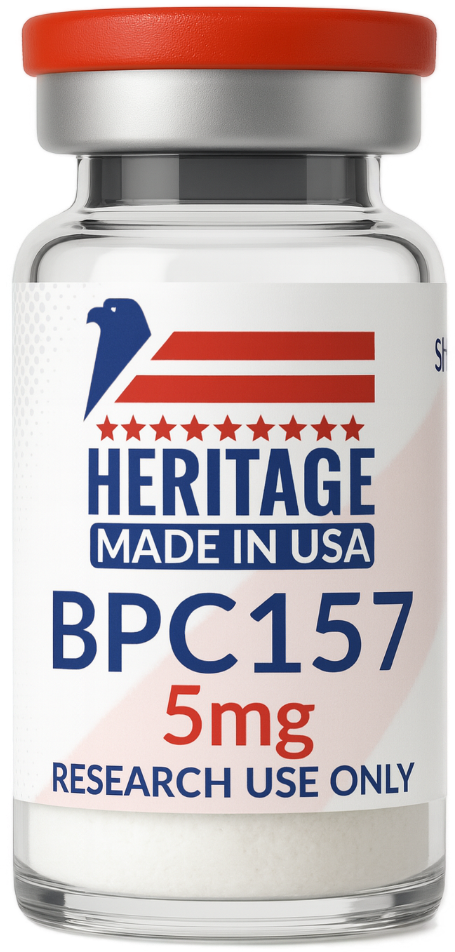
What is BPC-157?
BPC-157 — short for Body Protection Compound-157 — is a 15-amino-acid peptide originally isolated from a protective protein in human gastric juice. Researchers at the University of Zagreb first characterized it in the early 1990s, and it's been generating interest ever since. One thing that makes it unusual right off the bat: it's remarkably stable in stomach acid. Most peptides get chewed up instantly. BPC-157 comes from the gut, so it can handle that environment.
The research portfolio on this one is massive. We're talking over 100 preclinical studies covering tendon healing, muscle repair, bone fractures, nerve regeneration, and gut healing. The common thread? BPC-157 promotes angiogenesis — it helps grow new blood vessels at injury sites. That blood supply is what drives repair across all these different tissue types.
One finding that gets a lot of attention: BPC-157 appears to reverse NSAID-induced gut damage in animal models. Ibuprofen, diclofenac, aspirin — the peptide has shown protective effects against all of them. It's also been studied for alcohol-related gastric damage and inflammatory bowel disease models. Keep in mind, though — this is all animal data. No completed human trials yet.
Mechanism of Action
Nobody has pinned down a single mechanism for BPC-157 — it seems to work through multiple pathways simultaneously. After decades of preclinical work, here are the ones that keep showing up:
Nitric Oxide (NO) System
BPC-157 interacts with the nitric oxide system, which controls blood vessel dilation, blood flow, and tissue repair signaling. What's interesting is that it seems to work as a stabilizer rather than a simple on/off switch. Studies show it can counteract both NO-synthase inhibition (L-NAME) and NO-synthase overstimulation (L-arginine). Whether NO is too low or too high, BPC-157 nudges it back toward balance [4].
Growth Factor Upregulation
BPC-157 turns up the volume on several growth factors that drive tissue repair: VEGF (vascular endothelial growth factor), EGF (epidermal growth factor), and TGF-beta (transforming growth factor beta). The net result is angiogenesis — new blood vessels forming at injury sites, bringing oxygen and nutrients right where they're needed. This is probably the single biggest reason BPC-157 accelerates healing [2].
FAK-Paxillin Pathway
This pathway is all about cell movement. FAK-paxillin signaling controls how cells migrate, stick to surfaces, and spread out. BPC-157 activates this pathway, which gets fibroblasts and endothelial cells moving toward wound sites faster. More repair cells at the injury sooner means faster healing [3].
Neurotransmitter System Interactions
BPC-157 also touches the brain chemistry side of things. It appears to modulate dopamine receptor sensitivity and protect against dopamine-depleting agents. There are interactions with the serotonin and GABA systems too, and some animal studies have shown anxiety-reducing effects. This is one of those areas where the data is intriguing but still early.
Dosing Protocol
Dosing for BPC-157 has been pretty consistent across the research. Most studies use fixed doses, though you'll occasionally see weight-based protocols (1–10 mcg/kg, or roughly 0.5–4.5 mcg/lb) in the literature.
| Protocol | Dose | Frequency | Duration | Notes |
|---|---|---|---|---|
| Standard recovery | 250 mcg | Once daily | 4–8 weeks | Most commonly referenced in literature |
| Accelerated recovery | 250 mcg | Twice daily | 4–6 weeks | Split AM/PM dosing |
| High-dose protocol | 500 mcg | Once daily | 4–6 weeks | Used in some soft tissue injury studies |
| Localized injury | 250 mcg | 1–2x daily | 4–8 weeks | SubQ injection proximal to injury site |
| GI protocol | 500 mcg | Once daily | 4–8 weeks | Abdominal subcutaneous injection |
- Empty stomach works best — or at least 30 minutes before eating.
- Got a specific injury (tendon, muscle, joint)? Inject SubQ as close to it as you can get.
- For systemic or gut-related protocols, abdominal subcutaneous injection is the standard approach.
- There's no evidence that you build tolerance to BPC-157, but cycling off periodically is still considered good practice.
Reconstitution Guide
BPC-157 plays nice with BAC water — it dissolves quickly without fuss. Just don't shake the vial. Ever.
- Remove the plastic cap from the BPC-157 vial and wipe the rubber stopper with an alcohol swab. Allow to dry.
- Draw
2 mLof bacteriostatic water into a sterile syringe. For a 5 mg vial, this yields a concentration of2,500 mcg/mL. - Insert the needle through the rubber stopper at a slight angle. Inject the water slowly against the inner wall of the vial — do not spray directly onto the peptide powder.
- Allow the vial to sit for 1–2 minutes. Gently roll the vial between your palms if needed. Do not shake or vortex.
- The solution should be completely clear and colorless. Discard if you observe any cloudiness, particulate matter, or discoloration.
5 mg vial + 2 mL BAC water: Concentration = 2,500 mcg/mL
250 mcg dose = 10 units (0.1 mL) on a 100-unit insulin syringe
500 mcg dose = 20 units (0.2 mL) on a 100-unit insulin syringe
Doses per vial: 20 doses at 250 mcg, or 10 doses at 500 mcg
- 3 vials BPC-157 (5 mg each) — provides 60 doses, covers 56 days with margin
- 3 vials bacteriostatic water (30 mL each)
- 60 insulin syringes (29–31 gauge, 100-unit)
- Alcohol prep pads
Injection Technique
BPC-157 goes subcutaneous (SubQ). It's the most common and practical route, and once you've done it a few times it becomes second nature.
- Clean the injection site with an alcohol swab and allow it to air dry completely (approximately 30 seconds). Common sites: lower abdomen (2 inches from the navel), upper thigh, or proximal to the target injury.
- Draw the dose. Insert the needle into the vial through the rubber stopper. Invert the vial and draw the calculated number of units slowly. Tap the syringe to move any air bubbles to the top, then push them out gently.
- Pinch the skin at the injection site to create a fold of subcutaneous tissue. Insert the needle at a 45- to 90-degree angle in a quick, smooth motion. Release the skin fold.
- Inject slowly. Depress the plunger steadily over 5–10 seconds. Withdraw the needle at the same angle it was inserted. Apply gentle pressure with a clean swab if needed.
Don't keep hitting the same spot. Rotate your injection sites to prevent lipodystrophy (localized changes in the fat tissue). For abdominal shots, work your way around the navel like a clock. For injury-targeted protocols, alternate between 2–3 spots near the affected area. Keep at least 1 inch between sites.
Storage & Stability
BPC-157 is tougher than most peptides — its gastric acid resistance gives it an edge in stability. Still, you'll want to store it properly to get the most out of every vial.
- Store vials upright, out of direct light.
- If you see condensation on a cold vial, let it warm to room temp before opening — moisture getting inside is bad news.
- Never re-freeze a reconstituted vial. If it sat out at room temp for more than 4 hours, toss it.
- Pro tip: label each vial with the date you reconstituted it so you know when the 30-day clock runs out.
Side Effects & Considerations
In the safety department, BPC-157 looks very clean across the preclinical literature. Nobody has been able to establish a lethal dose (LD50), even at concentrations way beyond what's used in typical protocols.
Commonly Reported
- Injection site irritation — some redness, minor swelling, or itching. Usually gone within 30 minutes.
- Nausea — not common, but more likely at higher doses (500 mcg+) or if you inject on a full stomach.
- Lightheadedness — rare, and usually only in the first few days as your body adjusts.
Theoretical Considerations
- BPC-157 is a strong promoter of new blood vessel growth. No published study has linked it to tumor promotion, but if you have an active malignancy, the theoretical risk of feeding blood vessels to a tumor is worth taking seriously.
- Since BPC-157 affects the NO system and vascular tone, interactions with blood pressure medications are theoretically possible. Something to keep on your radar.
- Important caveat: no human clinical trials have been completed yet. Everything we know about safety comes from animal studies.
BPC-157 is a research peptide. It's not FDA-approved for any clinical use. Everything in this guide comes from published preclinical research — none of it is medical advice or a treatment recommendation.
Stacking Protocols
BPC-157 shows up in combination protocols constantly. The pairing you'll see most often is with TB-500 (Thymosin Beta-4 fragment) — it's become the default recovery stack in the research community.
BPC-157 + TB-500 (Recovery Stack)
There's a reason this combo is everywhere. BPC-157 works locally — promoting tissue repair and growing new blood vessels right at the injury site. TB-500 works systemically, tamping down inflammation and getting cells to migrate where they're needed. Different mechanisms, no overlap, and they seem to amplify each other's effects.
| Peptide | Dose | Frequency | Duration |
|---|---|---|---|
| BPC-157 | 250 mcg | Once daily (near injury) | 4–8 weeks |
| TB-500 | 2–2.5 mg | Twice weekly (loading) | 4–6 weeks |
| TB-500 (maintenance) | 2 mg | Every 2 weeks | Ongoing |
Lifestyle Factors
Peptides aren't a substitute for the basics. These habits can meaningfully support what BPC-157 is doing under the hood:
- Sleep: Your body does its heaviest repair work during deep sleep, when growth hormone peaks. Aim for 7–9 hours — this isn't optional during a recovery protocol.
- Protein: BPC-157 can initiate tissue remodeling, but your body needs amino acids to actually build with. Target 1.2–1.6 g/kg body weight (roughly 0.5–0.7 g/lb).
- Hydration: Water keeps blood flowing and nutrients moving to healing tissues. Don't overthink it — just drink enough.
- Gentle movement: Easy, low-impact activity boosts blood flow to the injury without reinjury risk. Save the heavy training for after the recovery cycle.
BPC-157 is available in 5 mg vials from Heritage Labs USA, a U.S.-based research peptide supplier with batch-level purity verification.
- Third-party purity testing (HPLC & MS)
- U.S.-based fulfillment
- Published COAs per lot
Literature & Citations
- Sikiric P, Hahm KB, Blagaic AB, et al. Pentadecapeptide BPC 157 and its role in healing: A comprehensive review. Curr Pharm Des. 2018;24(18):2012-2032. PubMed
- Seiwerth S, Brcic L, Vuletic LB, et al. BPC 157 and blood vessels. Curr Pharm Des. 2014;20(7):1014-1025. PubMed
- Chang CH, Tsai WC, Lin MS, et al. The promoting effect of pentadecapeptide BPC 157 on tendon healing involves tendon outgrowth, cell survival, and cell migration. J Appl Physiol. 2011;110(3):774-780. PubMed
- Sikiric P, Seiwerth S, Rucman R, et al. Stable gastric pentadecapeptide BPC 157-NO-system relation. Curr Pharm Des. 2014;20(7):1126-1135. PubMed
- Vukojevic J, Siroglavic M, Kasun M, et al. Rat inferior caval vein (ICV) ligature and BPC 157. Vasc Pharmacol. 2018;106:46-59. PubMed
- Sikiric P, et al. Brain-gut axis and pentadecapeptide BPC 157: Theoretical and practical implications. Curr Neuropharmacol. 2016;14(8):857-865. PubMed
- Staresinic M, et al. Gastric pentadecapeptide BPC 157 accelerates healing of transected rat Achilles tendon and in vitro stimulates tendocytes growth. J Orthop Res. 2003;21(6):976-983. PubMed
- Sebecic B, et al. Osteogenic effect of a gastric pentadecapeptide, BPC-157, on the healing of segmental bone defect in rabbits: a comparison with bone marrow and autologous cortical bone implantation. Bone. 1999;24(3):195-202. PubMed