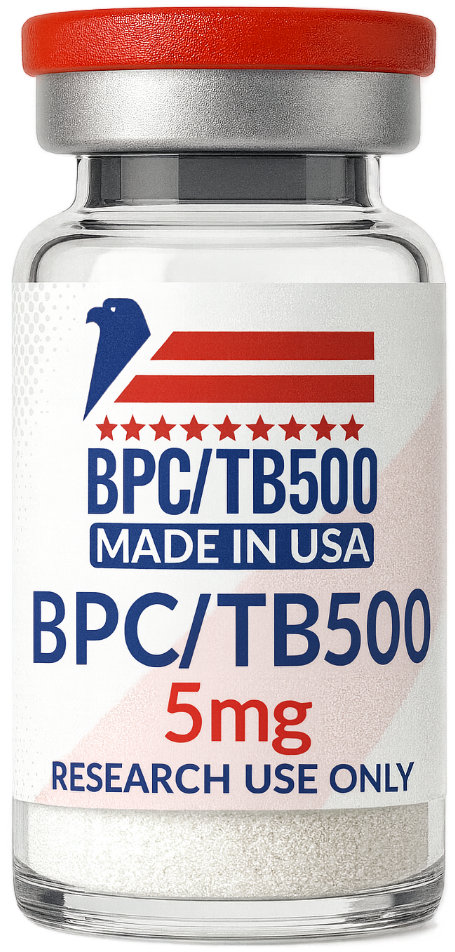
What is the BPC-157 / TB-500 Blend?
This blend puts the two most popular recovery peptides into one vial. Instead of juggling two separate vials, reconstituting each one, and doing the math for two different draws, you get both BPC-157 and TB-500 pre-combined. Same full dose of each, half the hassle.
Why combine them? Because they attack tissue repair from completely different angles. BPC-157 works locally — it modulates your nitric oxide system, ramps up growth factors (VEGF, EGF, TGF-beta), and gets repair cells moving to the injury via the FAK-paxillin pathway. TB-500 works systemically — it sequesters actin to enable cell migration, dials down NF-kB inflammatory signaling, and promotes blood vessel growth through its own VEGF pathways. Same goal, different roads getting there.
Individually, the evidence base is strong. BPC-157 has over 100 published studies behind it. TB-500 (from Thymosin Beta-4) shows up in cardiac repair, corneal healing, and wound recovery research. Formal studies on the combination are still limited, but the non-overlapping mechanisms and clean individual safety profiles make a compelling case. It's no accident this blend has become the go-to for recovery protocols in the peptide community.
Mechanism of Action
Each peptide in this blend pulls its weight through a different repair pathway. Here's why the combination works better than either one alone.
BPC-157: Nitric Oxide System Modulation
BPC-157 is a 15-amino acid peptide originally found in human gastric juice. Its relationship with nitric oxide is interesting — it doesn't just crank NO up or shut it down. It stabilizes the system, improving blood flow regulation and vascular tone right where the injury is. That creates the conditions tissue needs to actually heal [1].
BPC-157: Growth Factor Upregulation
On the growth factor side, BPC-157 cranks up VEGF, EGF, and TGF-beta — the signals that tell your body to build new blood vessels at the injury. That angiogenesis is really the core of what BPC-157 does. It also activates the FAK-paxillin pathway, which gets fibroblasts and endothelial cells physically moving toward the wound [4].
TB-500: Actin Sequestration & Cell Migration
TB-500 comes from Thymosin Beta-4, a protein that exists in virtually every cell in your body. What it does is grab G-actin monomers before they polymerize prematurely, then release them at the leading edge of migrating cells in a controlled way. Think of it as a traffic controller for cell movement — it gets repair cells where they need to be, efficiently, across any tissue type [2].
TB-500: Anti-Inflammatory Signaling
TB-500 also puts the brakes on NF-kB signaling — one of the body's main inflammatory switches. Less inflammation at the injury site means a better environment for actual repair to happen. And it promotes blood vessel growth through pathways that don't fully overlap with BPC-157's, which is part of why the two peptides seem to work better together than apart [3].
Synergistic Convergence
Here's the bottom line on why this combo makes sense: BPC-157 handles the local work — fixing up blood flow, pumping out growth factors, and getting cells to stick where they need to at the injury site. TB-500 handles the big picture — mobilizing cells from elsewhere in the body, calming systemic inflammation, and enabling the remodeling phase. You need both the local microenvironment and the systemic support for complete recovery, and this blend delivers on both fronts.
Dosing Protocol
Each vial contains 5 mg BPC-157 and 5 mg TB-500 (10 mg total). When you draw a dose, you're getting equal amounts of both peptides automatically.
| Protocol | Dose (per component) | Frequency | Duration | Notes |
|---|---|---|---|---|
| Loading phase | 250–500 mcg each | Once daily | 4 weeks | Aggressive initial repair window |
| Standard recovery | 250 mcg each | Once daily | 4–8 weeks | Most commonly used protocol |
| Maintenance | 150–250 mcg each | 3x per week | 4–8 weeks | Post-loading continuation |
| Acute injury | 500 mcg each | Once daily | 2–3 weeks | Short, high-dose burst for acute injuries |
| Localized injury | 250 mcg each | Once daily | 4–8 weeks | SubQ injection proximal to injury site |
- Empty stomach or at least 30 minutes before eating for best absorption.
- If you're targeting a specific injury (tendon, muscle, joint), inject as close to it as you can. BPC-157's local effects are strongest near the injection site.
- For general recovery, standard abdominal subcutaneous injection works well.
- The loading-then-maintenance approach comes from TB-500 protocols — you hit it hard initially to get cells migrating, then taper to a maintenance frequency.
Reconstitution Guide
Mix this blend with bacteriostatic water just like any other peptide. It dissolves easily. And yes — don't shake it.
- Remove the plastic cap from the blend vial and wipe the rubber stopper with an alcohol swab. Allow to dry completely.
- Draw
2 mLof bacteriostatic water into a sterile syringe. For a 5/5 mg (10 mg total) vial, this yields a concentration of2,500 mcg/mLof each peptide. - Insert the needle through the rubber stopper at a slight angle. Inject the water slowly against the inner wall of the vial — do not spray directly onto the peptide powder.
- Allow the vial to sit for 1–2 minutes. Gently roll the vial between your palms if needed. Do not shake or vortex.
- The solution should be completely clear and colorless. Discard if you observe any cloudiness, particulate matter, or discoloration.
5/5 mg vial + 2 mL BAC water: Concentration = 2,500 mcg BPC-157 + 2,500 mcg TB-500 per mL
250 mcg dose (of each) = 10 units (0.1 mL) on a 100-unit insulin syringe
500 mcg dose (of each) = 20 units (0.2 mL) on a 100-unit insulin syringe
Doses per vial: 20 doses at 250 mcg each, or 10 doses at 500 mcg each
- 3 vials BPC-157/TB-500 blend (5/5 mg each) — provides 30 doses at 500 mcg, covers 28 days with margin
- 3 vials bacteriostatic water (30 mL each)
- 30 insulin syringes (29–31 gauge, 100-unit)
- Alcohol prep pads
Injection Technique
Standard subcutaneous injection. If you're dealing with a specific injury, inject near that area — BPC-157 works best locally. TB-500 doesn't care where you inject; it distributes through your whole system regardless.
- Clean the injection site with an alcohol swab and allow it to air dry completely (approximately 30 seconds). Common sites: lower abdomen (2 inches from the navel), upper thigh, or proximal to the target injury.
- Draw the dose. Insert the needle into the vial through the rubber stopper. Invert the vial and draw the calculated number of units slowly. Tap the syringe to move any air bubbles to the top, then push them out gently.
- Pinch the skin at the injection site to create a fold of subcutaneous tissue. Insert the needle at a 45- to 90-degree angle in a quick, smooth motion. Release the skin fold.
- Inject slowly. Depress the plunger steadily over 5–10 seconds. Withdraw the needle at the same angle it was inserted. Apply gentle pressure with a clean swab if needed.
Targeting an injury? Get the needle as close to it as practical. BPC-157's growth factor effects are concentrated around where you inject. TB-500, on the other hand, enters the bloodstream and spreads everywhere — injection site doesn't matter for that component. If you're running a general recovery protocol, rotate abdominal injection sites in a clock pattern around the navel.
Storage & Stability
With a blend, you follow the storage rules of the more sensitive component. In this case, that's TB-500, which has a shorter shelf life than BPC-157 once reconstituted.
- Store vials upright, out of direct light.
- The 21-day window is set by TB-500's stability. Don't push past it just because BPC-157 on its own would last longer.
- Never re-freeze a reconstituted vial. If it sat out at room temp for more than 4 hours, toss it.
- Pro tip: write the reconstitution date on the vial so you know when the 21-day window expires.
Side Effects & Considerations
What you can expect mirrors the individual safety profiles of both peptides, which are well-documented across preclinical research. Neither compound raises major red flags on its own, and the combo doesn't seem to introduce new concerns.
Commonly Reported
- Injection site reactions — some redness, swelling, or itching that clears up within 30 minutes.
- Fatigue during the loading phase — this comes from TB-500 and your body's systemic repair kicking in. Usually passes after the first week.
- Nausea — uncommon, but more likely if you're pushing 500 mcg+ of each component.
- A brief head rush or lightheadedness right after injecting — resolves in minutes and isn't a concern.
Theoretical Considerations
- Both peptides strongly promote new blood vessel growth. No study has linked them to tumor promotion, but if you have an active cancer, the theoretical risk of feeding blood vessels to it is worth taking seriously.
- TB-500's vascular remodeling effects could theoretically interact with cardiovascular medications.
- BPC-157's NO system effects create possible interactions with blood pressure medications.
- Neither peptide has been through human clinical trials as a therapeutic agent — all the safety data is preclinical.
This blend is a research product — not FDA-approved for any clinical use. Everything here comes from published preclinical research. It's not medical advice.
Stacking Protocols
Since this blend already IS the most popular recovery stack, adding more peptides is about covering angles that BPC and TB don't already handle.
BPC/TB Blend + GHK-Cu (Comprehensive Recovery Stack)
GHK-Cu brings something the other two don't: collagen synthesis and gene expression modulation. While BPC-157 and TB-500 focus on getting cells to the injury and building blood supply, GHK-Cu handles the rebuilding phase — laying down new collagen and elastin in the extracellular matrix.
| Peptide | Dose | Frequency | Duration |
|---|---|---|---|
| BPC/TB Blend | 250 mcg each | Once daily | 4–8 weeks |
| GHK-Cu | 200–500 mcg | Once daily | 4–8 weeks |
Lifestyle Factors
Peptides won't out-perform bad habits. These basics make a real difference in how fast you recover:
- Sleep: Your body's repair machinery runs hardest during deep sleep when GH peaks. 7–9 hours isn't negotiable during a recovery protocol.
- Protein: These peptides kick off tissue remodeling, but you need amino acids to build with. Target 1.2–1.6 g/kg (about 0.5–0.7 g/lb) body weight daily.
- Hydration: Blood flow and nutrient transport to healing tissue depend on it. Keep drinking.
- Easy movement: Light activity gets blood moving to the injury without risking re-damage. Hold off on anything intense in the target area until the cycle's done.
The BPC-157/TB-500 blend is available in 5 mg/5 mg combination vials from Heritage Labs USA, a U.S.-based research peptide supplier with batch-level purity verification.
- Third-party purity testing (HPLC & MS)
- U.S.-based fulfillment
- Published COAs per lot
Literature & Citations
- Sikiric P, Hahm KB, Blagaic AB, et al. Pentadecapeptide BPC 157 and its role in healing: A comprehensive review. Curr Pharm Des. 2018;24(18):2012-2032. PubMed
- Goldstein AL, Hannappel E, Kleinman HK. Thymosin beta4: actin-sequestering protein moonlights to repair injured tissues. Trends Mol Med. 2005;11(9):421-429. PubMed
- Bock-Marquette I, Saxena A, White MD, et al. Thymosin beta4 activates integrin-linked kinase and promotes cardiac cell migration, survival and cardiac repair. Nature. 2004;432(7016):466-472. PubMed
- Chang CH, Tsai WC, Lin MS, et al. The promoting effect of pentadecapeptide BPC 157 on tendon healing involves tendon outgrowth, cell survival, and cell migration. J Appl Physiol. 2011;110(3):774-780. PubMed
- Seiwerth S, Brcic L, Vuletic LB, et al. BPC 157 and blood vessels. Curr Pharm Des. 2014;20(7):1014-1025. PubMed
- Sosne G, Qiu P, Goldstein AL, Wheater M. Biological activities of thymosin beta4 defined by active sites in short peptide sequences. FASEB J. 2010;24(7):2144-2151. PubMed
- Sikiric P, Seiwerth S, Rucman R, et al. Stable gastric pentadecapeptide BPC 157-NO-system relation. Curr Pharm Des. 2014;20(7):1126-1135. PubMed
- Malinda KM, Sidhu GS, Mani H, et al. Thymosin beta4 accelerates wound healing. J Invest Dermatol. 1999;113(3):364-368. PubMed