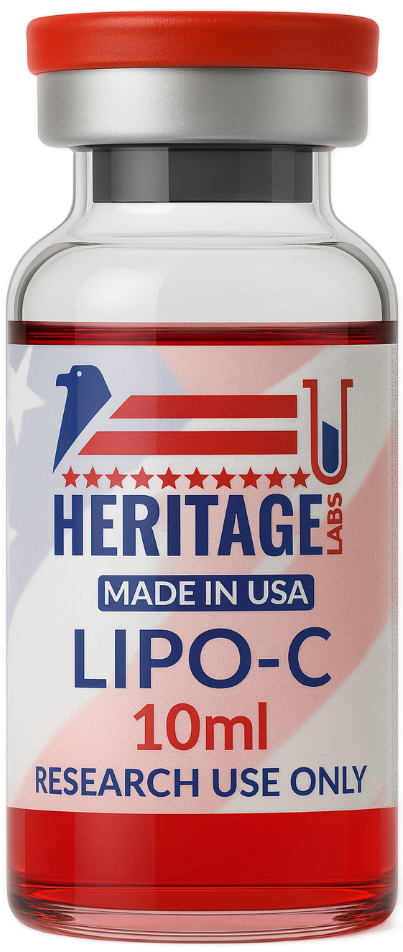
What is LIPO-C?
LIPO-C is a lipotropic injection — a combo of methionine, inositol, choline (the "MIC" trio), plus vitamin B12. Lipotropics help your liver move fat and bile more efficiently, supporting fat metabolism and preventing the liver from hoarding fat it shouldn't be holding onto. You'll find it in weight management clinics everywhere as an add-on to diet and exercise.
Each component serves a specific metabolic function. Methionine is an essential amino acid that acts as a lipotropic agent by assisting in the breakdown of fats, preventing fat buildup in the liver, and providing sulfur for the production of glutathione, the body's primary intracellular antioxidant. Inositol, a member of the B-vitamin family, is involved in fat transport and metabolism, insulin signal transduction, and serotonin modulation. Choline is essential for the synthesis of phosphatidylcholine, a major component of cell membranes and VLDL particles that transport fat from the liver. Vitamin B12 is critical for energy metabolism, red blood cell formation, and neurological function.
MIC+B12 has been a staple in clinical weight management for decades. Each ingredient has a clear metabolic role, and putting them together covers multiple fat metabolism pathways at once. Going injectable means you get full bioavailability of everything, which is especially important for B12 — a lot of people don't absorb it well orally due to low intrinsic factor or gut issues.
Mechanism of Action
LIPO-C works through the synergistic action of four components, each targeting a different aspect of hepatic fat metabolism and energy production.
Methionine — Methylation & Glutathione
Methionine is converted to S-adenosylmethionine (SAMe), the body's primary methyl donor, which is required for phosphatidylcholine synthesis in the liver. Phosphatidylcholine is essential for VLDL assembly — the mechanism by which fat is exported from the liver. Methionine deficiency leads to hepatic fat accumulation. Additionally, methionine provides the sulfur atom for cysteine and glutathione synthesis, supporting hepatic detoxification and antioxidant capacity [1].
Inositol — Insulin Signaling & Fat Transport
Myo-inositol is a precursor to phosphatidylinositol, a membrane phospholipid involved in insulin signal transduction. It has shown insulin-sensitizing effects in polycystic ovary syndrome (PCOS) studies and supports hepatic lipid export via VLDL assembly. Inositol also modulates serotonin receptor sensitivity, which may influence appetite regulation and mood — relevant factors in weight management [3].
Choline — VLDL Assembly & Fat Export
Choline is the most critical lipotropic factor. It is required for the synthesis of phosphatidylcholine, which constitutes the surface monolayer of VLDL particles. Without adequate choline, the liver cannot assemble and secrete VLDL, leading to fat accumulation (non-alcoholic fatty liver disease). Choline deficiency is remarkably common — over 90% of the U.S. population fails to meet the adequate intake level [2].
Cyanocobalamin (B12) — Energy Metabolism
Vitamin B12 is a cofactor for methionine synthase (which regenerates methionine from homocysteine) and methylmalonyl-CoA mutase (which metabolizes odd-chain fatty acids and certain amino acids). B12 deficiency impairs both methylation capacity and mitochondrial fatty acid metabolism. The injectable route provides 100% bioavailability, critical for individuals with absorption issues [4].
Dosing Protocol
LIPO-C dosing is straightforward as it comes in a pre-mixed, ready-to-use format. Standard dosing reflects decades of clinical weight management practice.
| Protocol | Dose | Frequency | Duration | Notes |
|---|---|---|---|---|
| Standard | 1 mL IM | 1–2x per week | Ongoing | IM in deltoid or gluteal region |
| Weight management | 1 mL IM | Twice weekly | During active weight loss | Combined with diet and exercise program |
| Maintenance | 1 mL IM | Once weekly | Ongoing | After reaching target weight |
- LIPO-C is not a standalone weight loss treatment. It is designed as an adjunct to proper nutrition and exercise.
- No cycling is required — the components are naturally occurring nutrients.
- Morning or early afternoon administration is preferred, as the B12 component can be energizing.
- Some practitioners increase to twice weekly during active weight loss phases and reduce to once weekly for maintenance.
Administration Guide
LIPO-C comes as a ready-to-use sterile solution. No reconstitution is required.
10 mL multi-dose vial: Ready-to-use solution. Draw 1 mL per dose using a sterile syringe.
Doses per vial: 10 doses at 1 mL each
Needle gauge: 22–25 gauge, 1–1.5 inch for IM injection
Injection sites: Deltoid, vastus lateralis (outer thigh), or dorsogluteal
- 2 vials LIPO-C (10 mL each) — provides 20 doses, covers 10 weeks at 2x/week
- 16 syringes with 22–25 gauge needles (1–1.5 inch)
- Alcohol prep pads
Injection Technique
LIPO-C is administered via intramuscular (IM) injection. IM delivery ensures rapid absorption of all four components.
- Clean the injection site with an alcohol swab and allow it to air dry completely (approximately 30 seconds). Common IM sites: deltoid (upper arm), vastus lateralis (outer thigh), or dorsogluteal (upper outer quadrant of buttock).
- Draw the dose. Using a 22–25 gauge needle, draw 1 mL from the multi-dose vial. Remove air bubbles by tapping the syringe and gently depressing the plunger.
- Insert the needle at 90 degrees into the muscle in a quick, smooth motion. Do not pinch the skin for IM injections — spread the skin taut instead (Z-track technique recommended).
- Inject at a moderate pace over 5–10 seconds. Withdraw the needle and apply gentle pressure with a clean swab. Do not massage the injection site (to prevent tracking of the solution).
Rotate between injection sites to prevent tissue irritation. For twice-weekly protocols, alternate between left and right sides (e.g., left deltoid Monday, right deltoid Thursday). Allow each site at least one week between injections. The solution may appear pink to red due to cyanocobalamin (B12) — this is normal and expected.
Storage & Stability
LIPO-C requires light protection due to the light-sensitive B12 component. Otherwise, storage is straightforward.
- Protect from light — cyanocobalamin (B12) degrades with light exposure. Store in the original box or wrap in foil.
- The pink/red color of the solution is from B12 and is completely normal.
- Multi-dose vials should be discarded 28 days after the first puncture to maintain sterility.
- Always use a new, sterile needle when drawing from the multi-dose vial.
Side Effects & Considerations
LIPO-C is composed of naturally occurring nutrients and has an excellent safety profile. Side effects are generally mild and infrequent.
Commonly Reported
- Injection site pain, swelling, or redness — typical of IM injections, usually mild and brief.
- Urine discoloration (pink/red) — from B12 excretion. Completely harmless.
Less Common
- Mild nausea or gastrointestinal discomfort — infrequent with injectable route.
- Body odor — from methionine metabolism to trimethylamine. Uncommon at standard doses.
- Allergic reaction to B12 — rare. Individuals with known cobalt allergy should avoid cyanocobalamin-containing formulations.
- Increased energy — may disrupt sleep if administered late in the day.
LIPO-C is a nutritional supplement combination, not a pharmaceutical drug. It is not a standalone weight loss treatment and should be used as part of a comprehensive program including proper nutrition and regular exercise. Individuals allergic to any component (particularly cobalt/B12) should not use this product. Contraindicated in individuals with Leber's disease (hereditary optic neuropathy) due to B12 content.
Stacking Protocols
LIPO-C is commonly combined with other metabolic support compounds. Its role in hepatic fat processing makes it complementary to compounds that increase fat mobilization or oxidation.
LIPO-C + L-Carnitine (Complete Fat Metabolism Stack)
LIPO-C supports hepatic fat processing (export via VLDL) while L-Carnitine handles mitochondrial fatty acid transport for oxidation. This combination addresses fat metabolism from liver to mitochondria.
| Compound | Dose | Frequency | Duration |
|---|---|---|---|
| LIPO-C | 1 mL IM | 1–2x per week | Ongoing |
| L-Carnitine | 200–600 mg IM | 3x per week | Ongoing |
Lifestyle Factors
LIPO-C is most effective when combined with active lifestyle management:
- Nutrition: A balanced diet with adequate protein supports the metabolic pathways that LIPO-C components facilitate. Avoid excessive alcohol, which competes with methionine metabolism.
- Exercise: Regular physical activity increases fat mobilization and utilization, providing the substrate that lipotropic compounds help process.
- Hydration: Adequate water intake supports kidney function and the excretion of metabolic byproducts.
- Timing: Morning or early afternoon administration leverages the energizing effect of B12 without disrupting sleep.
LIPO-C is available in 10 mL multi-dose vials from Heritage Labs USA, a U.S.-based research supplier with batch-level purity verification.
- Third-party purity testing (HPLC & MS)
- U.S.-based fulfillment
- Published COAs per lot
Literature & Citations
- Brosnan JT, Brosnan ME. The sulfur-containing amino acids: an overview. J Nutr. 2006;136(6 Suppl):1636S-1640S. PubMed
- Zeisel SH, da Costa KA. Choline: an essential nutrient for public health. Nutr Rev. 2009;67(11):615-623. PubMed
- Croze ML, Soulage CO. Potential role and therapeutic interests of myo-inositol in metabolic diseases. Biochimie. 2013;95(10):1811-1827. PubMed
- Stabler SP. Vitamin B12 deficiency. N Engl J Med. 2013;368(2):149-160. PubMed
- Fischer LM, daCosta KA, Kwock L, et al. Sex and menopausal status influence human dietary requirements for the nutrient choline. Am J Clin Nutr. 2007;85(5):1275-1285. PubMed
- Mato JM, Martínez-Chantar ML, Lu SC. Methionine metabolism and liver disease. Annu Rev Nutr. 2008;28:273-293. PubMed